
Our Editor speaks to Graham Kendrick, one of the most influential Christian songwriters of his generation, about his time with Youth for Christ, the enduring power of music and having confidence in the gospel message.
When did you first hear about Youth for Christ?
Youth for Christ was known generally in the circles I moved in when I was in my late teens and early twenties. I started off in a local church band, then I moved to performing as a singer-songwriter and got involved in evangelism using music. Phil Vogel, who was heading up Youth for Christ in the early ‘70s, was a great innovator in the generation ahead of me.
How did you first get involved?
While I was a student, Clive Calver, who had recently graduated from London Bible College and was involved in student evangelism, invited me to sing at an event. The music was the attraction and he would preach. When he didn’t have a musician with him he would set up a disco deck, play records and use them as talking points, which was quite innovative in those days. I ended up doing several events with him. Then, in 1973 he came to me with the idea of forming a travelling ministry team that would help churches do local mission. I’d already been involved in some local missions that had proved very effective. So, I was already on that trajectory.
What led you to join the movement?
After about two and a half years, Clive got recruited to head up Youth for Christ at 27 years old. Because he and I had a very fruitful working relationship, I decided I would stick with him and joined Youth for Christ. Pretty soon, we created a music department and I started to gather freelance musicians similar to myself, who needed a sense of belonging and a place where we could support each other through the pressures of travelling music ministry. That was the beginning of several years I spent with Youth for Christ. It was an era of tours and roadshows.
Who were the tours mainly aimed at?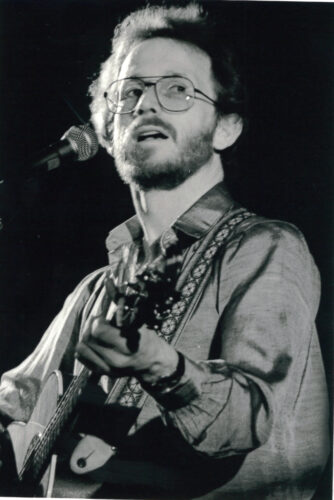
Clive was very much an exhorter, a shaker, a mover and a mobiliser. He was very concerned to get young Christian people involved in evangelism. He believed that the prime task of an evangelist is to get the church evangelising, not to do it for them. So, Youth for Christ tours in those days carried a call to be disciples of Jesus who took seriously His command to make disciples.
Was a particular tour most significant?
For me, the ‘Fighter Tour’ was. I wrote a bunch of songs calling Christians to get serious about our faith and made an album for it. Clive got together with Pete Meadows, originally a guitar player from one of the early 1970s Christian bands, who had established ‘Buzz’ magazine, which by then was the main youth magazine. Together, they conceived the idea of gathering young people for a residential festival-come-training in evangelism event and called it ‘Spring Harvest’. In 1978, Clive and I embarked on the 55 date Fighter Tour and distributed thousands of flyers advertising the new event, which went ahead the following Easter with around 3000 young people. For Clive as National Director of Youth for Christ, it was a further outworking of his vision to mobilise young Christians.
Did any personal experience inform the music for the ‘Fighter Tour’?
Certainly, God had been waking me up to recognise that there was a serious spiritual battle to fight. The key song: ‘God put a fighter in me’ was very much my testimony. On the tour, many people responded to the call to step up, join the fight and give their all. All the tours were significant in different ways but in my memory, it was the one that was most powerful. It was the springboard to other things like Spring Harvest and subsequently, for me, the writing of songs for an evolving movement which was much wider than Youth for Christ.
How did your ministry develop through your time with Youth for Christ?
There was a spiritual renewal gathering momentum at that time, and many were hungry to engage with God through experiencing the Holy Spirit in worship. One evening at the first Spring Harvest, which was styled somewhat like a music festival, popular Christian bands and artists were lined up to perform but there was a hunger in the young people in the crowd to worship. Clive asked me if, instead of doing my singer-songwriter performance set, I would lead worship. I’d written just a handful of praise songs by that time and still primarily thought of myself as a Christian artist but the tide of the Spirit was rising and young people wanted to go deeper. That was a pivot-point for me.
Of the late ‘70s and early ‘80s, Clive Calver has said, “Despite the 80 million mistakes we made, there was a sense of moving forward and positive progress being achieved”. Do you agree with that?
When you’re young and trying to pioneer new things, you make mistakes but it’s the way you learn. In the year of the Fighter Tour, the sheer pressure of work was overwhelming at times. We knew how to work hard but not how to rest, how to minister to others but we were not so good at nourishing our own spiritual lives. Despite our inexperience, we were, I think, in many ways establishing a new ethos for Youth for Christ at that time. I remember our leaders’ conferences, when those travelling around the country and those running the local centres would gather and report back. There was a lot of experimentation, innovation and drive. Clive tended to draw people who had energy and vision and wanted to see fresh things happen.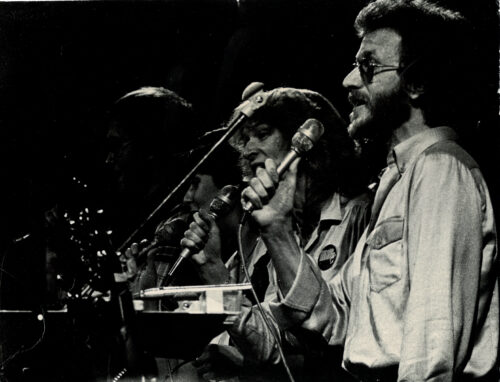
In the present day, our current national touring band team, ‘The Sense’, travel the country doing mission weeks and concerts. Do you see music continuing to play a part in youth evangelism in the future?
Oh, definitely. Music is a cultural language, in fact, a multitude of languages and forms a massive part of people’s lives. It can also be a neutral meeting ground. If a song touches a person, it can bypass barriers they may have to faith. Music can go straight to the heart and stir up questions that can then be answered. If the people playing it are genuine, prayerful and full of the Holy Spirit, the music can command an atmosphere where God’s presence can be strongly felt and in which people can open their hearts to the message.
What are you currently working on?
I’m writing songs and have some new ones coming out. A lot of them are co-writes with other writers, such as Lucy Grimble. This year I’ll be putting out an EP of four singer-songwriter songs to mark 50 years since my first album. The singer Jake Isaac challenged me to write some new songs in my original singer-songwriter style, which I’ve done
and recorded. They’ll be released around Easter time, together with a programme on TBN. Hopefully, as Covid retreats, I’ll also be doing more live events.
Finally, do you have a message for the Youth for Christ movement in its 75th year?
There are many religions and many ‘spiritualities’ competing for attention, but the story we Christians have is totally unique. We need to have the confidence to tell it as it is, with grace, compassion, humility and wisdom, of course. When Paul talks about the gospel he preached, he goes straight to the story. ‘For I handed on to you as of first importance what I in turn had received: that Christ died for our sins in accordance with the scriptures, and that he was buried, and that he was raised on the third day in accordance with the scriptures, and that he appeared to Cephas, then to the twelve’ (1 Cor 15:3-5, NRSV).
When we tell that story, it has its own power to reach people. The need today among young people is massive. So, have confidence in the message and in proclaiming it, but as those who are seeking to live it.